
From the Frontier: Long/Short Extensions

Traditional tax-loss harvesting is a tax savings strategy that involves selling securities at a loss to offset gains on other investments or income. There are limitations, though. Losses get harder to find as positions appreciate.
Long/short extensions (also called long/short direct indexing or long/short loss-harvesting) are strategies that can magnify the tax benefits of traditional tax-loss harvesting, address many of its limitations, and provide investors access to an approach once reserved for institutions. They can be particularly effective for those holding highly appreciated stock, considering a business sale, completing a real estate transaction, or planning to realize other capital gains in the future. They can also benefit an investor's existing portfolio by reducing the tax friction from rebalancing, repositioning, or withdrawals. The ongoing losses these strategies generate offset those gains directly.
What They Are
A long/short extension is an overlay added to your existing portfolio or to new cash. The extension holds two types of positions: long positions in stocks the manager expects to rise, and short positions against stocks the manager expects to lag. The proceeds from the shorts fund additional long positions, so your net exposure to the market stays where it was. You are still fully invested.
One configuration, for example, is called 130/30. For every $100 of market exposure, the portfolio holds $130 in long positions, which may include your existing holdings, and $30 in short positions against stocks the manager expects to underperform, all relative to a broad index like U.S. or global equities. The net is still $100 of market exposure. The extension can be sized larger or smaller depending on how many losses you need and how much variation from the index you are comfortable with. Larger extensions generate more losses and more opportunity to differ from the index, for better or worse. They also cost more.
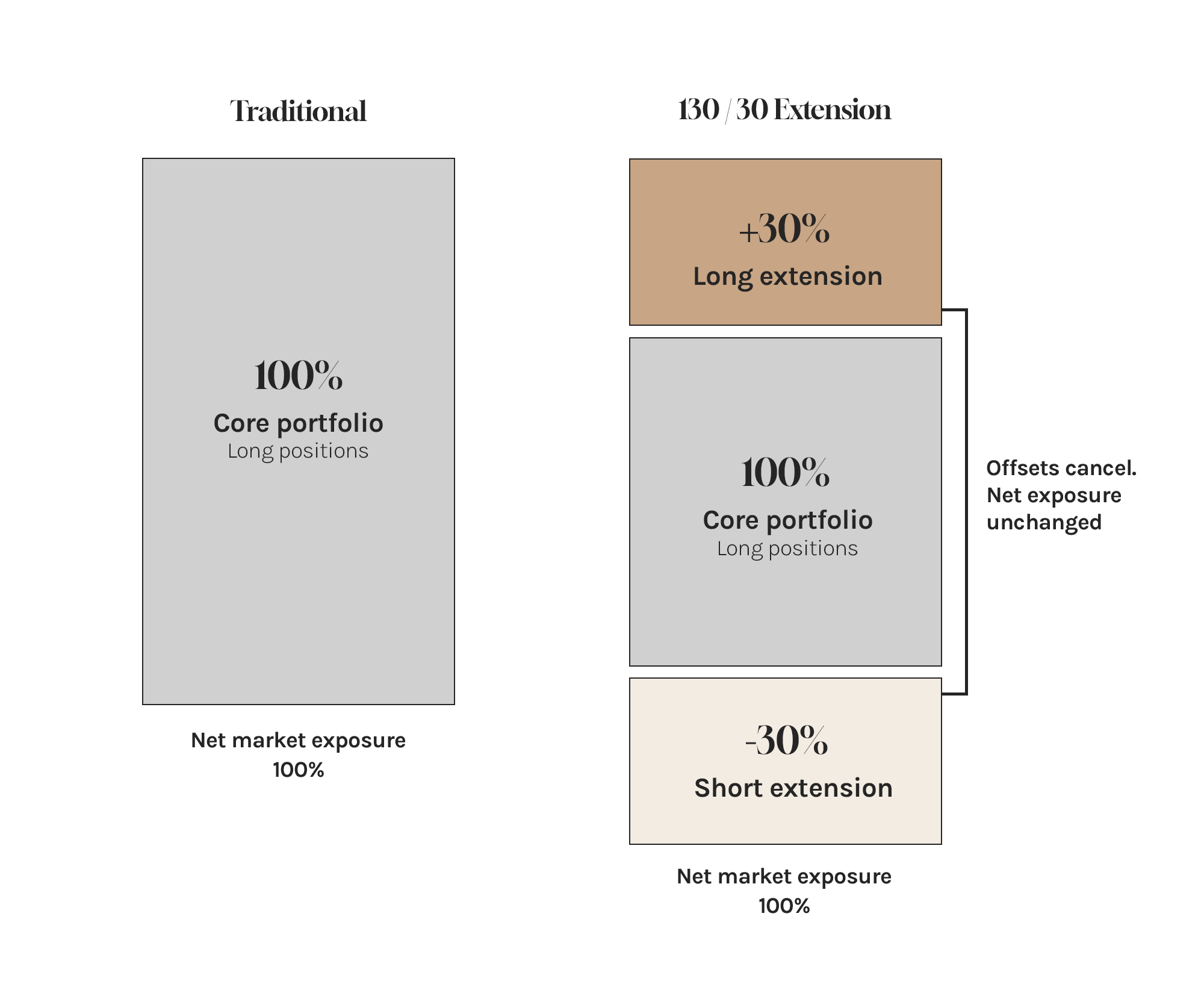
In a traditional portfolio, you can only harvest a tax loss when a stock falls. Short positions do the opposite. When a shorted stock rises in price, the short position loses money, and that loss can be harvested. The result is a strategy that produces tax losses in rising markets and falling ones, without changing your market exposure.
The process is systematic, managed by institutional firms that have run long/short equity strategies for decades and oversee tens of billions of dollars. They rank the universe of publicly traded stocks on characteristics like value, momentum, quality, and earnings consistency, going long the strongest and short the weakest. Because individual stock prices move constantly and independently, there is a steady supply of positions sitting on losses. Those positions are sold, the loss is captured, and a similar but not identical position is opened to maintain exposure. Markets do not have to fall to create opportunities.
The Tax Benefit
The strategy is traded to produce ongoing realized capital losses. Those losses come from individual positions, not the portfolio as a whole, and offset capital gains dollar for dollar on your tax return. The losses can be applied in a number of ways:
Common Applications

The losses generated are mostly short-term, offsetting short-term gains first. Remaining losses offset long-term gains. Losses that exceed your gains in a given year can offset up to $3,000 of ordinary income, and the rest carries forward indefinitely. The strategy produces the most losses in the early years but keeps generating them over time. Banked or recurring losses can also fund withdrawals, letting you take money out each year tax efficiently.
A lower current year tax bill can mean more dollars staying in the portfolio compounding. For appreciated assets held until death, a step-up in basis can reduce or eliminate the deferred tax for beneficiaries.
What It Costs and What You Get Back
These strategies come with real costs: margin interest on the additional long positions, stock borrowing fees on the short side, and manager fees. All in, a standard 130/30 typically runs 0.75% to 1.0% annually depending on the manager and the size of the extension. Some of these costs may be deductible, which lowers the net cost.
Unlike passive strategies, the managers apply active stock selection on both sides of the portfolio. The goal is return above the index after all costs, before counting the tax benefit. No strategy delivers that in every period.
Tracking Error and Risk
Active management means the portfolio will not track the index exactly. The expected deviation is measured as "tracking error." The lower the tracking error, the closer to the index the returns should be. Tracking error is not inherently good or bad. Some years the active positioning helps and in others it hurts. That variability is also a cost of the strategy.
Unwinding a Long/Short Extension
Over time the extension builds up gains of its own, the same way any long-held investment does. When it comes time to reduce or exit, how you do it matters. Wound down gradually over several years, the manager can use ongoing losses and accumulated carryforwards to offset those gains as positions close, returning capital with little or no tax due. Unwound quickly, a large gain gets realized at once and much of the tax benefit disappears. Larger extensions need more runway to exit cleanly. That belongs in the decision at the outset, not at the end.
Who This Is For
Long/short extensions are not the right tool for every investor. The strategy requires a taxable account large enough to fund it, a comfort level with some degree of active management, and the ability to source liquidity from elsewhere if needed. For the right investor, the applications are broad.

Many of our clients use multiple strategies from the Frontier of Tax-Aware Investing. For those clients, long/short extensions typically serve as the foundation, generating the realized losses that allow each strategy to work more efficiently and the combined tax benefits to build over time.
How It Works in Practice
These strategies are held in individually managed accounts in your name at a major custodian like Fidelity or Schwab. Every position is visible and tax-lot tracked, and losses are reported on the same Form 1099 you receive each year. It is straightforward for both you and your accountant at tax time.
Magnolia's Advisory Role
Getting real value from this strategy depends on how it is implemented. Which assets fund it, how large an extension to run, which capital gains events to plan around, and how all of it fits into your broader tax picture and financial plan. That coordination is where most of the value is created or lost.
We have spent considerable time vetting managers, working through the mechanics, and running these strategies for clients. We can tell you directly whether it makes sense for your situation and how to proceed if it does.
If you are sitting on a meaningful unrealized gain, expecting a significant taxable event, or simply want to know whether your portfolio is working as hard as it could after taxes, we would welcome the conversation.

Disclaimer: The opinions voiced and information provided in this document is for informational and educational purposes only. It should not be considered investment, financial, or legal advice. Nothing herein constitutes a recommendation to buy, sell, or hold any security or financial instrument. Magnolia Private Wealth does not provide tax, legal or accounting advice. Investing involves risk, including the potential loss of principal. You should consult with a qualified financial advisor, tax professional, or other appropriate professional before making any financial decisions. The author and publisher assume no liability for any losses or damages resulting from the use of this information.
Insights from Our Team.