Nvidia Envy

Right now, there’s a small team attempting to summit Mount Everest. It’s likely even they are aware of the current “issues” at Nvidia. We usually avoid finance jargon like “idiosyncratic risk,” but it’s having quite a moment.
Early investors in Nvidia stock may find a trip down memory lane painful: since it went public, the share price was cut by over half 7 times. The recent tumble (down 34% as we go to press) doesn’t even make the top 10. The timing of three won’t surprise anyone (the Dot-Com crash, the Great Financial Crisis, and Covid), but not the 90% drop1. And the volatility of NVDA’s share price has been nearly 60%: 3 to 4 times choppier than any major index. Idiosyncratic indeed!
You may see where we’re going with this: the moral of the story (OK, one moral) is that investors should own a diversified portfolio. On the other hand, $10,000 of Nvidia stock bought at the time of listing (and held) would still be worth over $44,000,000. To make a convincing case, we have a little work ahead of us.
For starters–whether through foresight or luck–an early investor found a needle in the haystack: only about 50 (one fifth of one percent) have achieved even a tenth of Nvidia’s gains…in the last 100 years.2
And the odds of finding that big winner are much worse today. Companies are going public later and larger, so pre-IPO investors capture most of the gains. (Sometimes all of the gains, while sticking the public shareholders with losses. WeWork was a famous “busted IPO”: it didn’t go public quite as planned, and as a result incinerated only $9B of shareholder wealth, not the intended $47B.3)
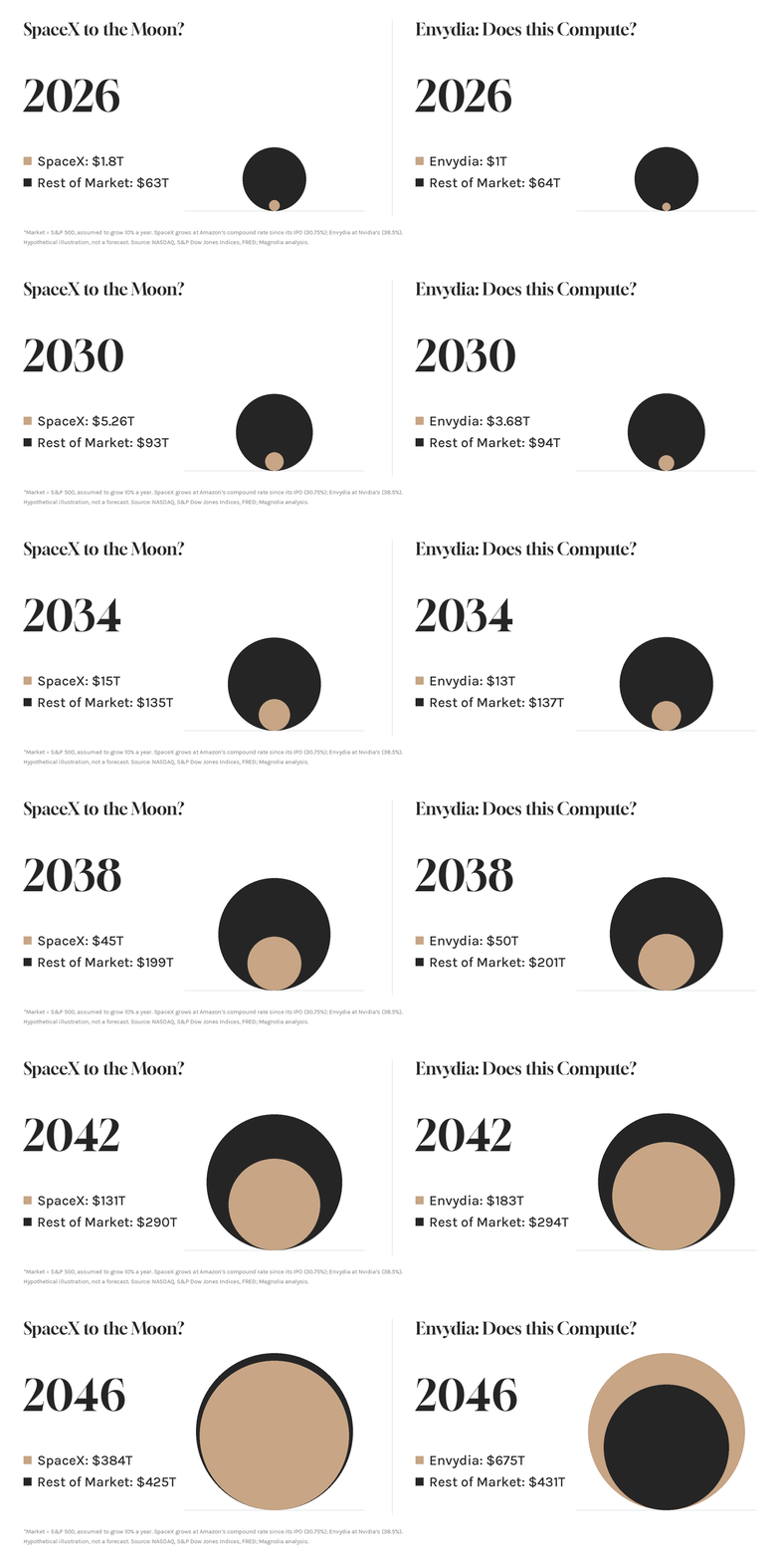
When they come to market later and larger, the likelihood of delivering the historical gains of the Amazons and Apples is essentially nil: the math doesn’t math. We recently asked: what has to be true for SpaceX’s stock to deliver Amazon-like returns after going public? The answer: it will have to quickly eclipse the rest of the market!
Nvidia makes the case even better! Say an out-of-work CEO takes charge of a company (we’ll call it Envydia) and takes it public at a mere $1T valuation (SpaceX was $1.8T). Don’t blink.
The odds always favor diversification, but there’s a wrinkle: diversification is getting harder to achieve. A broad portfolio of large stocks (e.g., an index fund) is more diversified, so if one company hits a landmine, others are outside the blast radius. Owning bonds sometimes helps. However (as we’ve noted in our August newsletter and elsewhere), the AI buildout is sucking up so much capital that both sides of a traditional portfolio are hostage to the same trade.
If a diversified portfolio is something you might be interested in, there are a few things you should know:
- True diversification requires owning asset classes beyond stocks and bonds, ones that may be less familiar.
- You should own them to improve a portfolio: by adding to expected returns, improving risk-adjusted returns, or both.
- Diversification sounds like a way to play defense. In reality, as we demonstrate to our clients, diversification helps on offense too.
- Nothing is free: you’ll likely own some of both Nvidia and Envydia, but not enough to buy an island. The substantial benefits of diversification will accrue to investors who understand how it works and what to expect.
Finally, diversification means saying goodbye to some of your $44,000,000 of NVDA. Worried about the tax bill? Will it be more than 34%? If you’d rather not wait for the next idiosyncratic event to impair your portfolio, we have another suggestion: ask us about both diversifying strategies and tax-aware investing. We can help with both the destination and the journey.

1 Jan 3, 2002–Oct 10, 2002 (Source: testfolio.io).
2 Hendrik Bessembinder, Te-Feng Chen, Goeun Choi, and K. C. John Wei, "Long-Term Shareholder Returns: Evidence from 64,000 Global Stocks," Financial Analysts Journal 79, no. 3 (2023): 33–63; Magnolia analysis.
3 WeWork ultimately went public through a business combination with BowX Acquisition Corp., a SPAC.
Hypothetical illustration, not a forecast. Past performance is not indicative of future results.
Disclaimer: The opinions voiced and information provided in this document is for informational and educational purposes only. It should not be considered investment, financial, or legal advice. Nothing herein constitutes a recommendation to buy, sell, or hold any security or financial instrument. Magnolia Private Wealth does not provide tax, legal or accounting advice. Investing involves risk, including the potential loss of principal. You should consult with a qualified financial advisor, tax professional, or other appropriate professional before making any financial decisions. The author and publisher assume no liability for any losses or damages resulting from the use of this information.
Insights from Our Team.