
Why are Bond Yields Rising?

Bond yields have been rising. Businesses seeking financing have noticed. Bondholders have noticed. Home buyers looking for a mortgage have noticed.
Journalists and pundits have noticed. Cue the “explanations” for why yields are rising, why the market is wrong, and what will trigger the next move.
We too have noticed the rise in rates. Fortunately for both us and our clients, we don’t have to fill space every day or week with our latest take, nor do we claim we have a crystal ball.
Experience has taught us to start with what we can observe before claiming to explain it, to exercise caution, and to consider competing narratives. And when investing, that preparation beats prediction every time.
If we hold a differentiated view that we think the market isn’t pricing in, the burden lies squarely on us to explain how the behavior of market participants—the actors that make a market—produces a different answer than ours.
So what can we say about bonds? The yield on the 10-year Treasury has been closely tracking the price of crude oil futures. According to one writer in the Wall Street Journal, investors may be “making a mistake to pay…attention to oil,”1 and therefore “yields might have risen too much."1
10-year Treasury yield vs. WTI crude oil
Over the past decade, oil and the 10-year have moved together in broad swings, but the link has loosened since 2022.
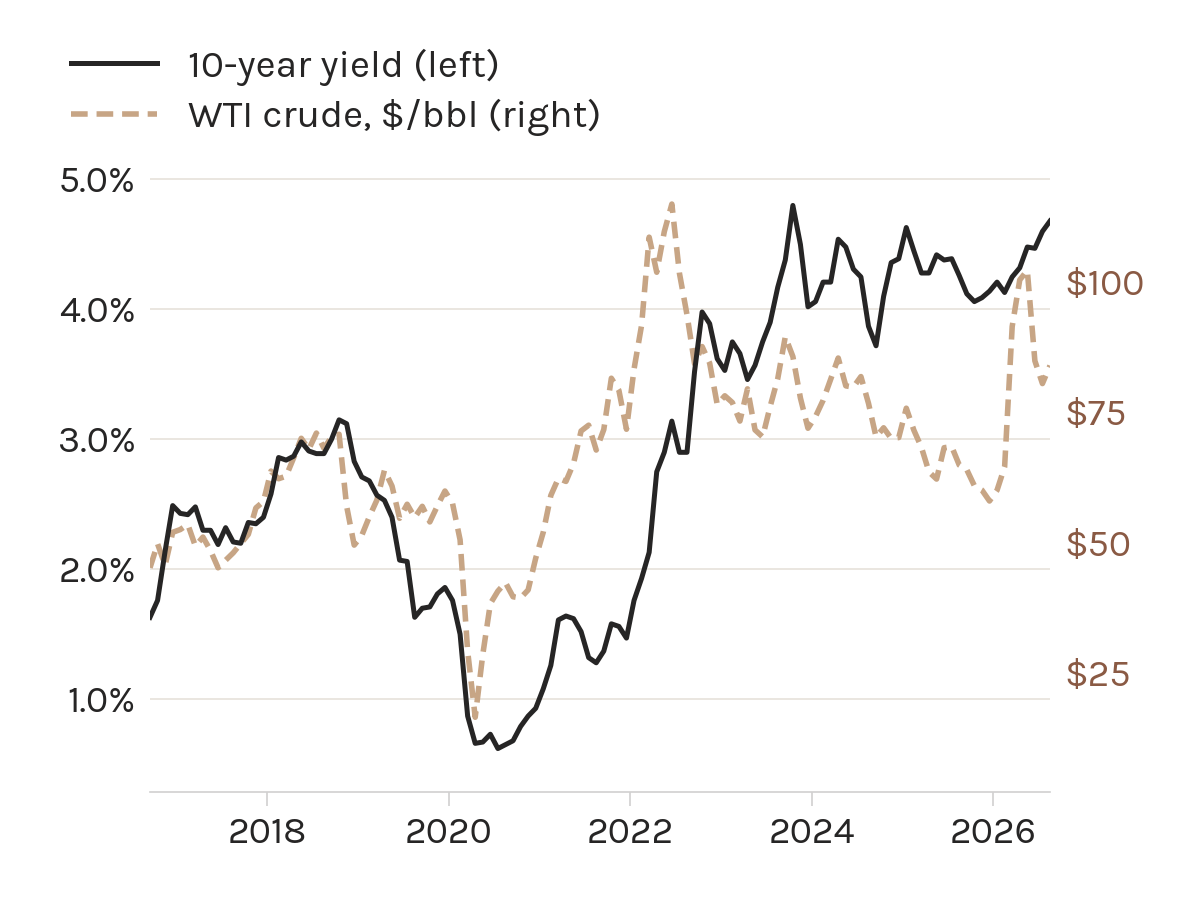
In this narrative, why is the market wrong? The “explanation” here is that oil prices are driving inflation and in turn driving the Fed to raise short-term rates. Indeed, changes in oil prices are one component of inflation, but the bond market-implied estimate of long-term inflation is still muted. The Federal Reserve is certainly not ignorant of this metric, nor are bond traders.
10-year Treasury yield vs. 5y5y forward inflation
Long-run inflation expectations explain much of the 10-year’s path, but the yield has pulled well above them since 2023.
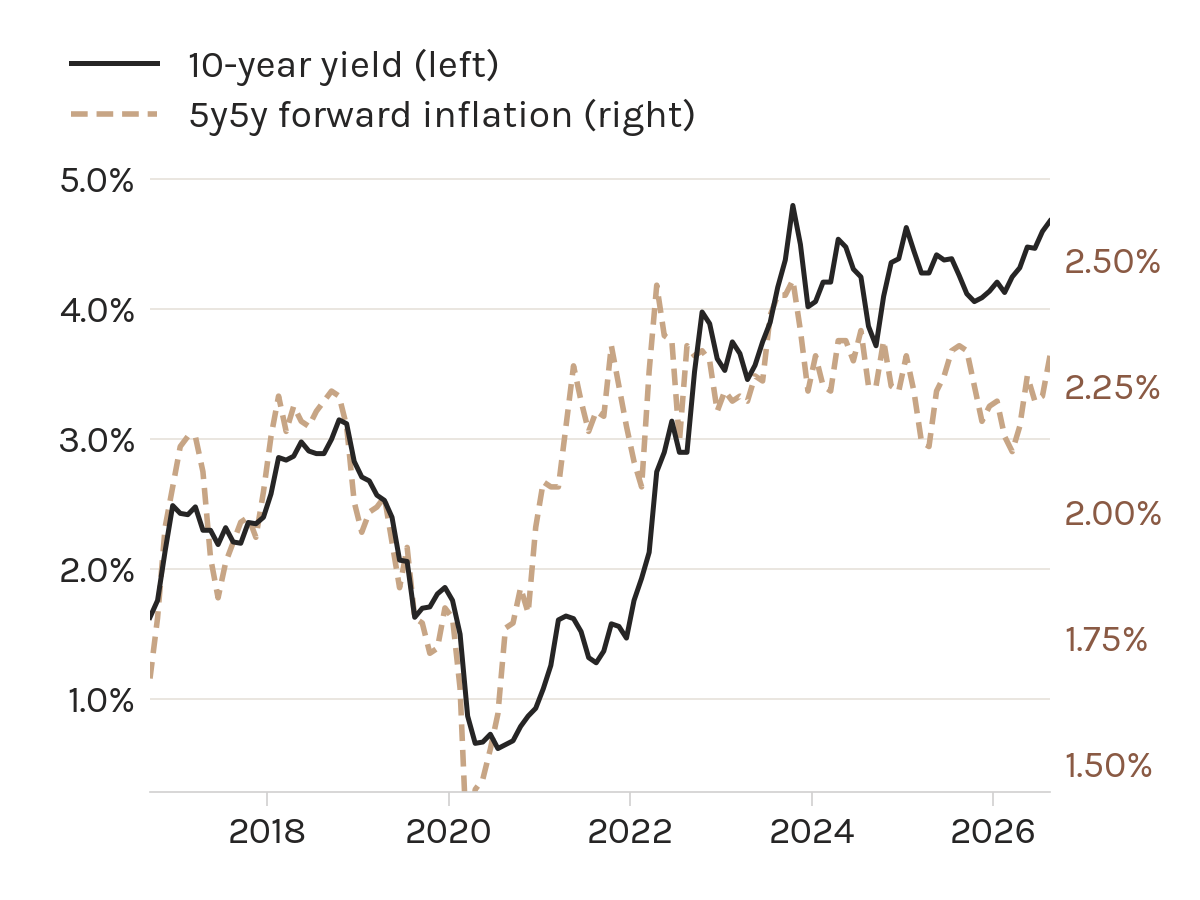
Are the bond traders wrong? If so, what are they getting wrong: 10-year yields or inflation expectations? Both? These would be bold claims: bond traders are the last people we like to see at high-stakes poker games.
We’ll propose one competing narrative. Taking a longer view of history, we observe that 10-year yields have tracked changes in nominal GDP–noisily but consistently.
10-year Treasury yield vs. nominal GDP growth, 1953–2026
Since the 1950s, the 10-year yield has tracked the trend in nominal growth closely, through the rise to the early-1980s peak, the long decline and the recent turn higher.
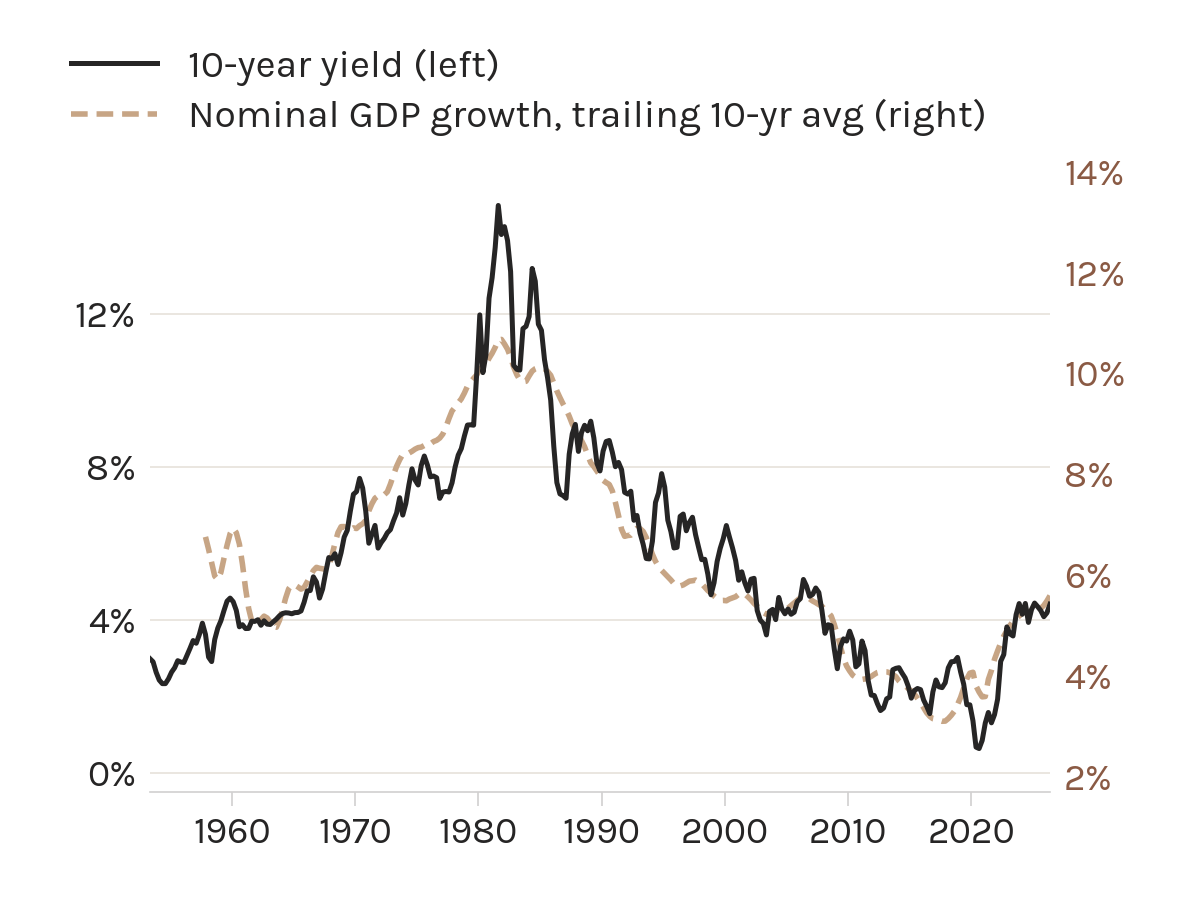
This relationship raises the question: are 10-year rates too low? Again, we’re not bond traders, but we can offer a competing narrative: perhaps the GDP estimates are too high? How could this be? Maybe the economists are wrong. Maybe analysts’ estimates of revenue are too high.2 Aha! Here are two groups we’re very comfortable taking potshots at.
Here’s another one we flagged in our last newsletter: the unprecedented level of capital expenditure driven by AI investment has led to a massive supply of new corporate debt, which competes directly with Treasury bonds for demand from asset allocators.
There’s a saying in asset management that there’s no such thing as a bad backtest. It’s a warning to be cautious extrapolating historical relationships in the data to the future, i.e., to make predictions.
These observations drive competing narratives. How can we know which provide the soundest explanations for the rise in bond yields? How much should we read into the current tight relationship between yields and oil prices? Maybe some observers are paying too much attention to the relationship between the two: missing the forest for the trees.
Financial markets don’t follow laws like Newtonian physics does. The past provides hints (often), explanations (sometimes), and predictions (rarely). Markets don’t incorporate all information immediately, but they’re smarter than most of us most of the time. Bold predictions are the domain of traders: they make for a few legends and a lot of burnt fingers. The economy is running hot right now and the stove is on.

Disclaimer: The opinions voiced and information provided in this document is for informational and educational purposes only. It should not be considered investment, financial, or legal advice. Nothing herein constitutes a recommendation to buy, sell, or hold any security or financial instrument. Magnolia Private Wealth does not provide tax, legal or accounting advice. Investing involves risk, including the potential loss of principal. You should consult with a qualified financial advisor, tax professional, or other appropriate professional before making any financial decisions. The author and publisher assume no liability for any losses or damages resulting from the use of this information.
Insights from Our Team.